


One of the questions I get most often from investors is, "What is your Total Addressable Market for Embodied AI?"
It’s a reasonable question. Investors are trying to determine how large an opportunity can become and whether a company has enough room to grow into something meaningful. Yet after more than three decades building technology companies, raising capital, running a VC and PE firm, serving on private and public company boards, and participating in multiple technology revolutions, I’ve become increasingly convinced that TAM is often one of the most misunderstood concepts in investing.
The reason is simple. TAM analysis works reasonably well when a company is pursuing an existing market with an incremental improvement. It works much less well when a technology fundamentally changes what a product can do. In those situations, the market itself changes. New use cases emerge. New customers appear. Entirely new categories are created. The future no longer resembles the present, which means the assumptions underlying the original TAM analysis become increasingly irrelevant.
My perspective on this was shaped long before I became CEO of Palladyne AI.
For much of my career, I have had a front-row seat to some of the most important technology transitions of the last thirty years. I co-founded and led Clearwire where we introduced the concept of true wireless broadband by building the first nationwide 4G wireless network across the US and several European countries. At Clearwire, I had the privilege of working alongside the entrepreneurs that built McCaw Cellular and VoiceStream, companies that eventually became AT&T Wireless and T-Mobile. And I have also had the privilege of serving on the board of directors and chairing the Strategic Review Committee of Globalstar, where we led the satellite communications industry with the first direct to cell phone satellite communications capabilities.
What I took away from these experiences was not an appreciation for how accurate market forecasts can be, but rather quite the opposite.
I learned that the largest TAM forecasting errors occur when a technology fundamentally changes what people and businesses are capable of doing. More specifically, when technology cost-effectively enables greater productivity. In those moments, analysts often assume the future will look like a somewhat improved version of the present. Instead, entirely new behaviors emerge, new use cases appear, and markets expand far beyond their original definitions.
The cellular industry provides a perfect example.
In the early days of cellular, mobile phones were viewed as expensive specialty devices used primarily by executives, salespeople, and other professionals who needed mobility. One of the most frequently cited forecasts from that era projected fewer than one million cellular subscribers by the year 2000. At the time, that estimate seemed entirely reasonable. Handsets were expensive. Networks were limited. Coverage was sparse. Most people simply could not imagine why everyone would need a mobile phone.
What happened next was not simply a story of adoption exceeding expectations. It was a story of technology changing the nature of the product itself. Networks improved. Coverage expanded. Devices became smaller, more reliable, and dramatically less expensive. As mobility became accessible to ordinary consumers, the market expanded far beyond its original definition. By the year 2000, the United States alone had approximately 109 million wireless subscribers. Today there are hundreds of millions of wireless connections in the United States and billions worldwide.
The forecasts were not off by twenty percent. They were not off by fifty percent. They were off by more than one hundred times because the forecasters were estimating demand for the product that existed at the time rather than the product that would eventually emerge.
The same pattern appeared in two decades earlier with personal computing.
When Microsoft signed its original DOS agreement with IBM in 1981, there were only about 500,000 personal computers installed worldwide. IBM reportedly forecast sales of roughly 240,000 PCs over the following five years. Looking back, those numbers seem almost comical, but they reflected how most people viewed computers at the time. Computers were specialized tools for hobbyists, engineers, researchers, and large enterprises. Very few people envisioned a world in which virtually every desk, every office, every school, and eventually every home would contain a computer.
What changed was not simply the hardware. The operating system transformed the computer from a specialized machine into a broadly useful platform that ordinary people could use. Software dramatically expanded both the utility of the machine and the size of the market. Today there are roughly 1.5 billion PCs in use around the world. The original forecasts were not wrong because analysts misunderstood market share. They were wrong because they underestimated what software would enable computers to become.
A generation later, the same mistake happened again.
Before Apple launched the iPhone in 2007, smartphones were generally viewed as a niche category serving business users. Global smartphone shipments were roughly 100 million units annually. Most industry forecasts assumed smartphones would remain a relatively small subset of the broader handset market, just as business-oriented devices had for years. Those forecasts were logical if one assumed that smartphones were simply better phones.
The iPhone demonstrated that smartphones were not merely phones. They were software platforms that happened to fit in your pocket. I had the opportunity to meet with Steve Jobs around the time Apple was introducing the iPhone. What struck me was that he didn’t think of the iPhone as a better phone. In his mind, it was an entirely new category. While much of the industry was debating handset features and market share, Apple was building a mobile computing platform that happened to make phone calls.
The distinction mattered enormously. Once software transformed the device, entirely new categories emerged. Navigation, ride sharing, mobile commerce, social media, streaming media, mobile gaming, digital payments, and countless other applications followed. Today more than a billion smartphones ship annually, and there are billions of smartphone users worldwide. Once again, the market proved dramatically larger than the original estimates because software fundamentally changed what the device could do.
Over time, I began to recognize a pattern. The greatest TAM forecasting errors in history often occur when software makes a machine intelligent.
When software transformed computers into productivity platforms, the market exploded. When software transformed phones into intelligent mobile computing devices, the market exploded. In both cases, analysts underestimated the opportunity because they were measuring the machine instead of measuring the capabilities that software would eventually unlock.
I believe we are witnessing a similar transition today in robotics, autonomous systems, and embodied AI.
Most discussions about autonomy focus on how many robots, drones, or autonomous vehicles will be sold. Analysts build models around unit volumes, hardware categories, and deployment forecasts. Those exercises are useful, but they may be asking the wrong question.
The more important question is what happens when machines become intelligent.
Today, most drones are remotely piloted or pre-programmed. Most industrial robots operate in highly structured environments and require extensive programming. Most machines still depend heavily on human decisions whenever conditions change. As a result, enormous categories of work remain beyond the reach of traditional automation. The limitation is not the machine itself. The limitation is the machine’s inability to perceive, reason, adapt, and collaborate in dynamic environments.
That is the problem embodied autonomy seeks to solve.
At Palladyne AI, our focus is developing software that allows machines to perceive their environment, make decisions at the edge, adapt to changing conditions, and collaborate with other autonomous systems. We are not simply trying to automate existing processes. We are trying to enable machines to perform tasks that historically required human judgment, human adaptability, and human decision making.
The implications are significant because once machines can reliably perform those functions, the market expands far beyond robotics. The relevant comparison is no longer the number of robots sold each year. The relevant comparison becomes the amount of work that autonomous systems can perform. The opportunity expands into manufacturing, logistics, inspection, maintenance, security, defense, aerospace, transportation, energy, mining, agriculture, and countless other sectors where physical work is still largely dependent on human operators.
This perspective also explains why we participate in both software and hardware.
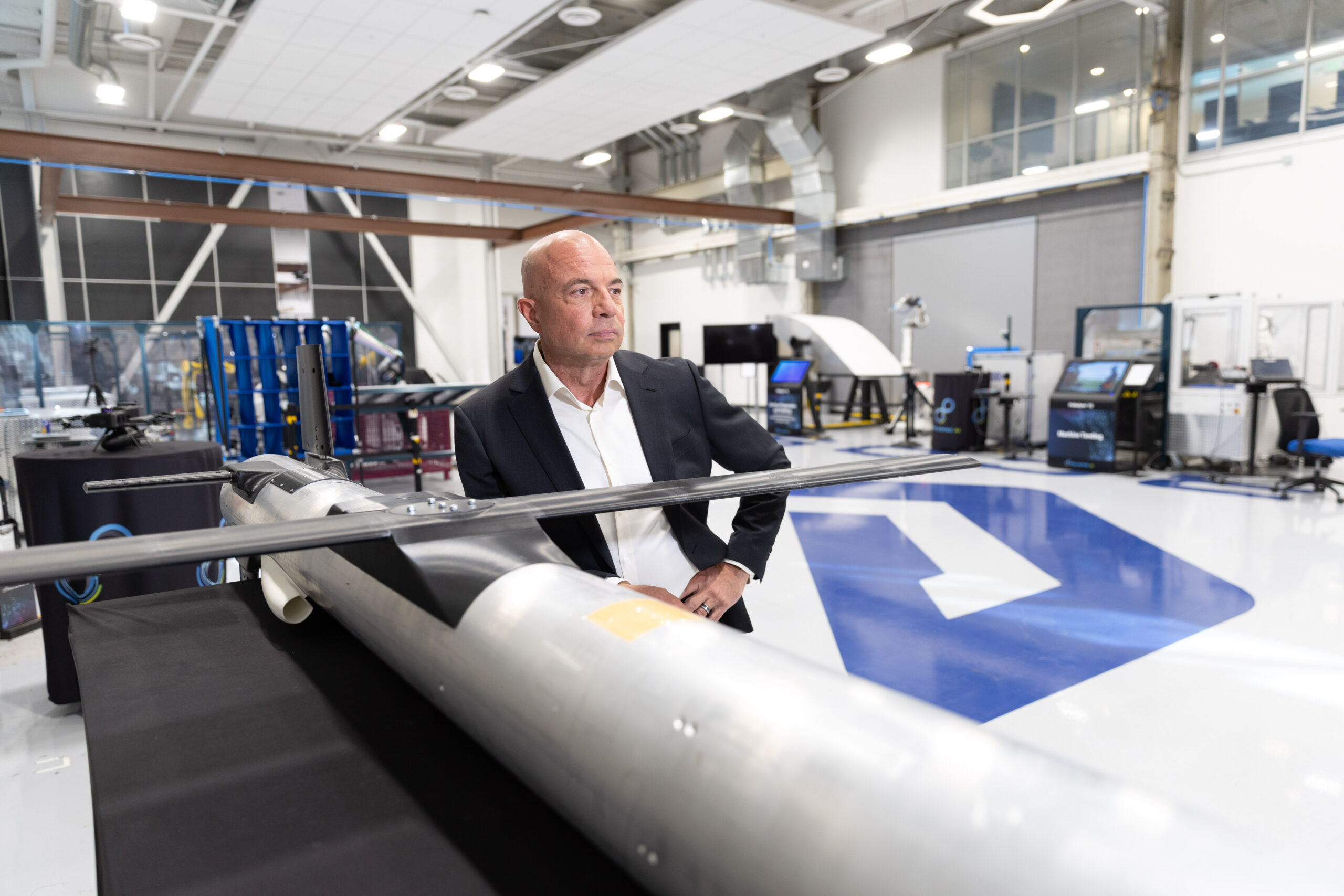
Occasionally investors ask why an AI company would own avionics technology, UAV platforms, manufacturing assets, and autonomous systems capabilities. The answer is that embodied AI, by definition, requires embodiment. Tesla provides a useful analogy. Increasingly, Tesla describes itself as an AI and robotics company. Yet Tesla still builds vehicles because the vehicle is the embodiment through which its intelligence creates value. We view autonomy in much the same way. The hardware provides the embodiment, but the long-term value resides in the autonomy layer that enables the machine to perceive, decide, adapt, and collaborate.
I’ll close with one final observation.
Today, some of the most valuable companies in the world are being built around algorithms that help people perform cognitive tasks more efficiently. Investors have assigned hundreds of billions—and in some cases trillions—of dollars of value to software that augments human thinking.
That raises an interesting question.
If intelligent software that helps people think is worth hundreds of billions of dollars, what is intelligent software that helps people do physical work worth?
What is software that enables machines to perform physical work, inspect infrastructure, operate equipment, manufacture products, deliver supplies, execute military missions, and collaborate autonomously worth? What happens when intelligence moves beyond screens and becomes embedded directly into the physical systems that power the global economy?
I don’t pretend to know the precise answer. History has made me skeptical of anyone who claims they do.
What I do know is that whenever software has made machines significantly more intelligent, the resulting opportunity has almost always turned out to be dramatically larger than the original TAM estimates suggested. That lesson has repeated itself in wireless communications, personal computing, and smartphones. I’m sure there are others.
The possibility that it may happen again is one of the reasons I find embodied autonomy so compelling.
Which is why, whenever someone asks me about TAM, my first instinct is to ask a different question: